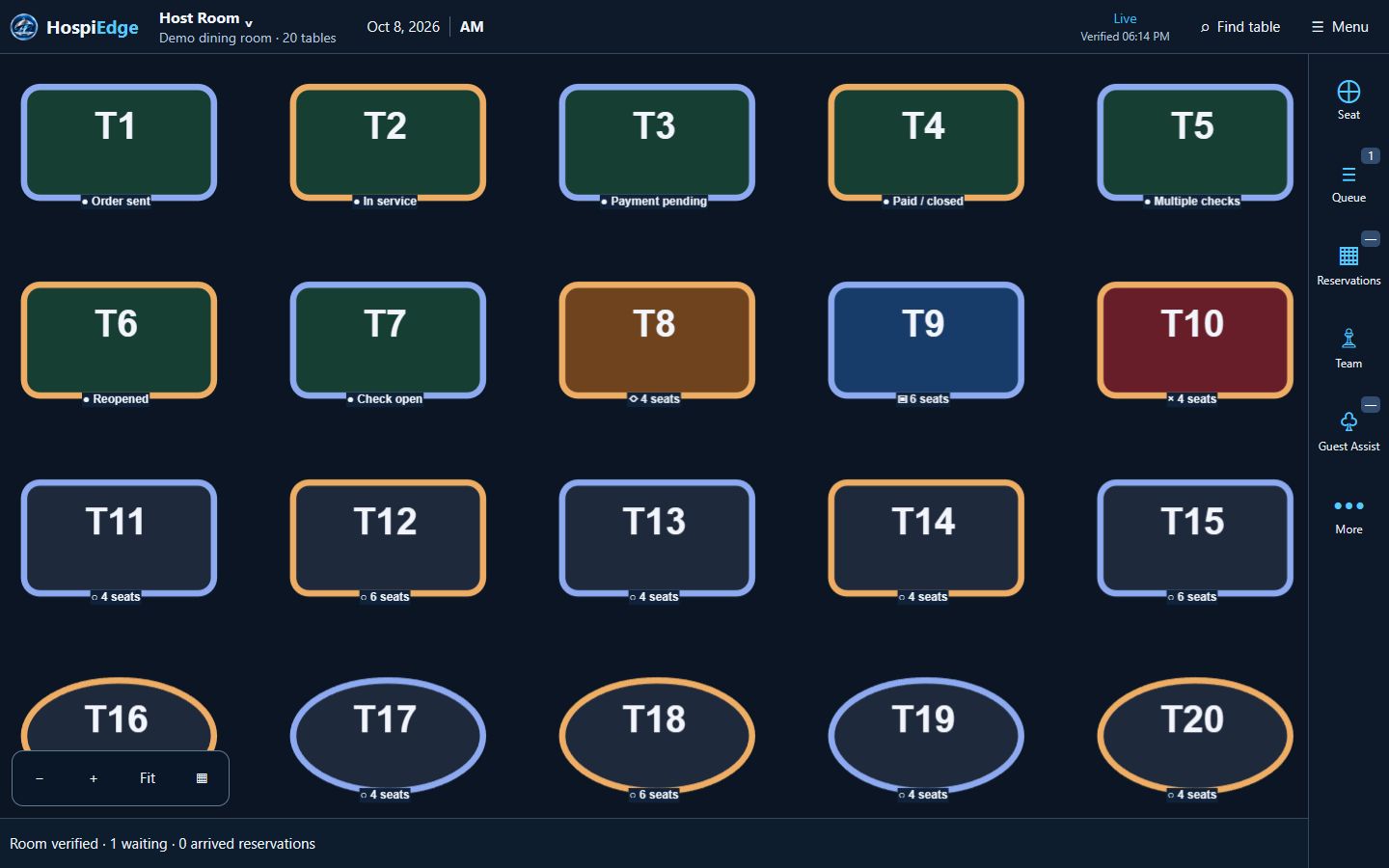
Host teams under rush pressure
Need clearer queue, floor, and table context when demand spikes and quote accuracy matters, especially when hosts have to balance ready parties against section pressure in seconds.
Use this guide when the buying question is seat-decision discipline: how quickly hosts can seat the next party, how evenly sections recover, and whether the room still stays controlled once service pressure rises.
Already know the workflow you want to review? Open the live app directly, keep the same work email across connected accounts, and add HospiEdge Agent only when leadership wants one cross-app command center above the stack. If the buying decision is still open, price the platform first and use Apps for workflow-fit review.
For guest-facing HETable discovery and booking, use Public Reservations. For public hiring traffic, use Hospi Jobs. Use hetable.com only when you want to review the live host-stand app itself.
This guide is for buyers defining the seat-decision model first: faster seat decisions, steadier section and station pacing, better guest flow, and a cleaner handoff into service.
Need clearer queue, floor, and table context when demand spikes and quote accuracy matters, especially when hosts have to balance ready parties against section pressure in seconds.
Need live pacing visibility, Smart Assign guidance, and section awareness to avoid overloading one server lane or station assignment, with a manager able to explain why the next seat went where it did.
Need better control over seat timing, section and station balance, and the handoff quality into live POS service.
Strong seating tools should prove both speed and decision quality at the host stand while protecting the downstream service lane.
Show available tables, suggested seating help, linked-table options, and section load together so speed does not break pacing.
Keep one service queue so teams can honor timing commitments, support notifications, and maximize flow without losing control.
Allow hosts and managers to shift assignments, drag seated parties, and rebalance the room as demand and staffing change.
These are the questions hosts and managers should be able to answer in seconds from the live view before moving into HETable review, Pricing, or rollout planning.
Identify ready reservations and walk-ins with complete queue context, including party notes, quoted waits, and nearby table readiness.
Use current table state, published floor context, and suggested seating cues before assigning the next party and pushing the room toward active service.
Review section load, station coverage, Smart Assign context, and whether hosts can drag a seated party to a better table without breaking the floor state.
Consider turn timing, near-term demand, and section recovery before confirming placement so one fast seat does not create a slow next 20 minutes.
These KPIs help operators verify that seating workflows are improving.
Frequent buyer questions about restaurant seating software.
Most teams see faster seat decisions, better section balance, and more consistent wait communication during peak windows.
Good systems combine party readiness, table state, section load, reservation timing, and suggested seating help so hosts do not over-prioritize any one factor.
Yes. Live table state and pacing context help teams avoid delayed resets and uneven server workload.
Ask about section setup, host training flow, waitlist integration, how quickly managers can adjust service rules on busy nights, and how the team reviews bad seat calls after service.
Use these pages only when the next question changes: floor visibility, waitlist execution, or the exact HETable lane for buyer review and live workflow proof.
HospiEdge is sold platform-first. One active HospiEdge platform account unlocks the app stack, AI is included in every platform plan, and bundle pricing is designed to be the clearest value path.
The main hospiedgetool.org account is not sold as a separate standalone app. It is the account-unlock layer that activates the broader HospiEdge stack for the bundled account count you choose.
Current launch pricing is $279/month or $2,899/year for 1 account, $749/month or $7,799/year for 3 accounts, and $2,190/month or $22,999/year for 10 accounts. AI is included in every platform plan.
After the launch-partner window, public platform pricing is planned at $349/month, $949/month, and $2,790/month for 1, 3, and 10 accounts.
Standalone pricing remains available where it makes sense: Schedule $199/month, HETable $249/month, POS $349/month, and Label $149/month. When the question is HETable, keep the buyer page, Public Reservations, and the live host-stand app route separate so the next link matches the real job. That keeps the platform bundle as the obvious value when more than one workflow matters.